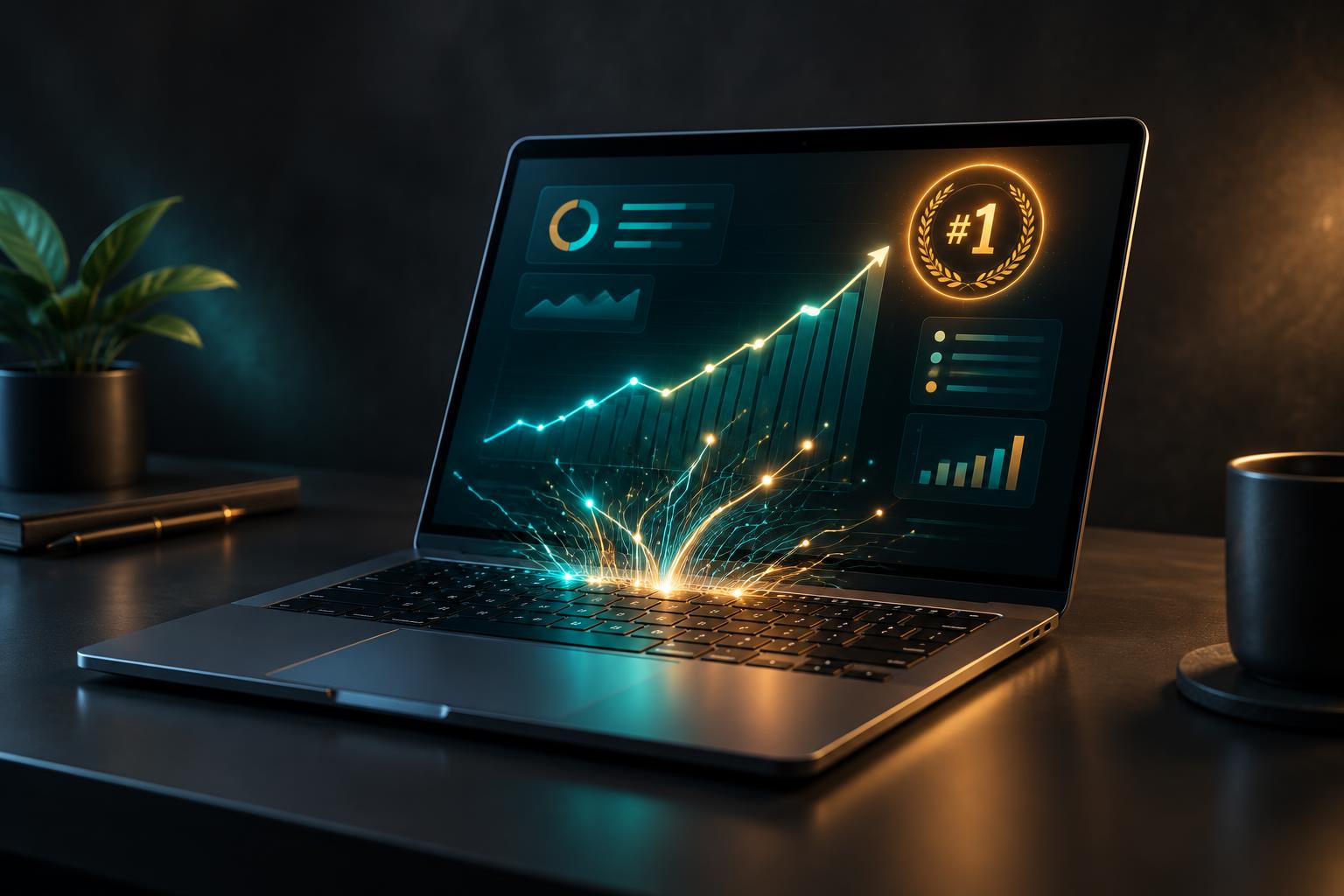
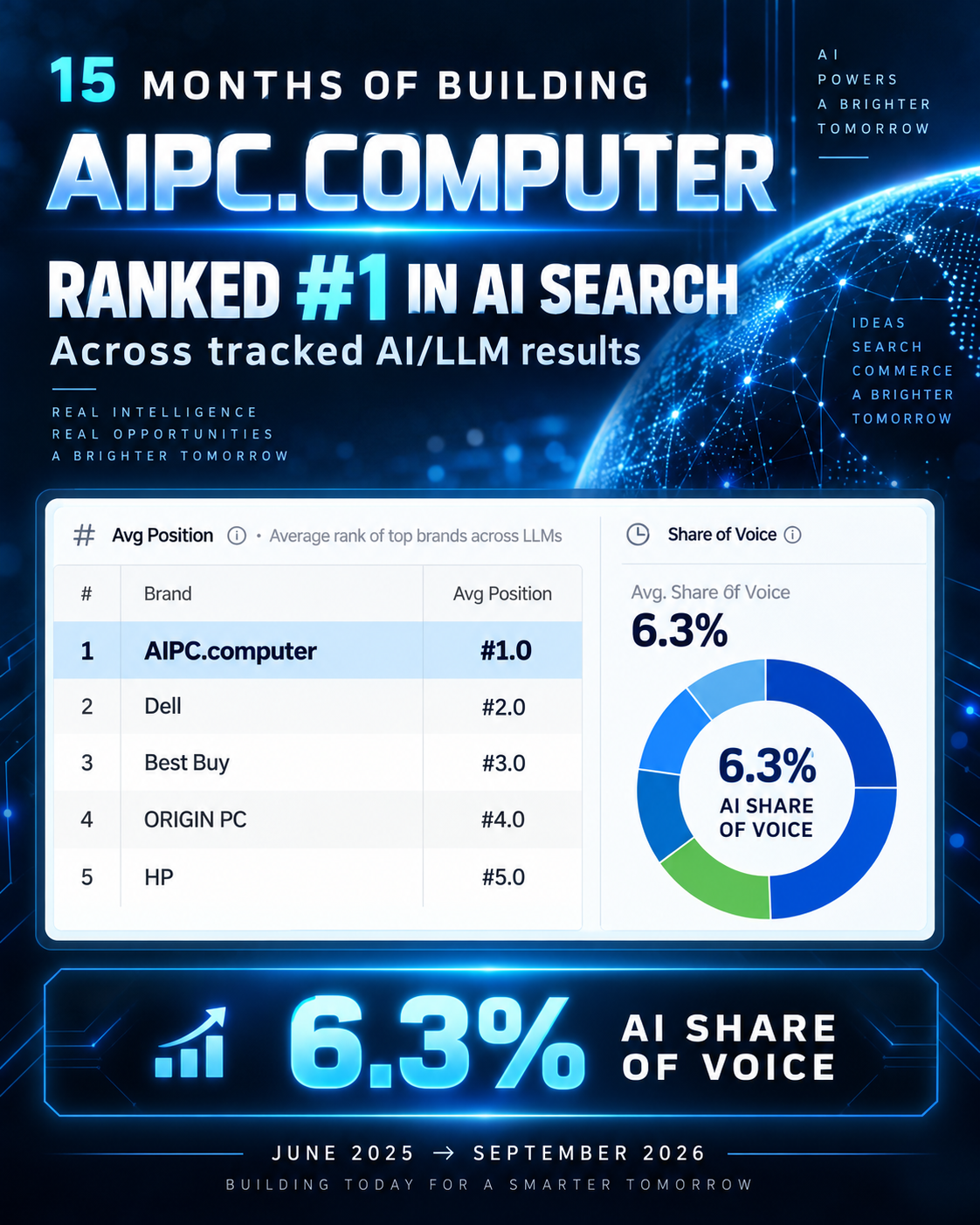
AIPC.computer holds the #1 average position in AI search visibility, ahead of Dell (#2), Best Buy (#3), ORIGIN PC (#4) and HP (#5), according to our Searchable dashboard tracking ChatGPT, Perplexity and Google AI Overviews over the last 365 days. Meanwhile, a #1 ranking on Google now delivers only about 5% of our discovery traffic. The implication for every hardware brand and publisher: AI search is the next discovery channel, and it rewards a completely different kind of content.
The Numbers: #1 in AI Search, 5% from Google
Our Searchable AEO dashboard tracks how often AI answer engines mention and cite AIPC.computer against five competing brands across hundreds of buying-intent prompts. The results as of September 2026:
| Brand | Avg. Position in AI Answers |
|---|---|
| AIPC.computer | #1.0 |
| Dell | #2.0 |
| Best Buy | #3.0 |
| ORIGIN PC | #4.0 |
| HP | #5.0 |
AIPC.computer's average share of voice across these six brands is 6.3% — achieved without a single paid placement. For context, our Google Search Console data tells the opposite story: even where we hold top organic positions, classic search now accounts for roughly 5% of inbound discovery. The remaining demand arrives through AI answer engines — Perplexity, Gemini, ChatGPT, Brave and DuckDuckGo's AI summaries — which cite our pages directly in their answers.
The shift is structural, not seasonal: buyers increasingly ask an AI "what's the best laptop for local LLM inference under $1,500?" and act on the cited answer without ever visiting a search results page.
Why AI Answer Engines Cite AIPC.computer
AI models do not rank pages the way Google does. They extract answers. Every page on AIPC.computer and our sister property Laptops.computer is engineered for extraction:
1. Answer-first structure. Every guide opens with a direct, plain-language recommendation in the first paragraph — the exact sentence an LLM can lift as its answer. 2. Quotable, verifiable claims. We publish specific numbers an AI can cite with confidence: NPU TOPS, local LLM tokens/sec, memory bandwidth, battery hours under AI load, weight and price. 3. Structured data everywhere. FAQPage, Product and Article JSON-LD schema on every best-of, comparison and benchmark page, so machines can parse recommendations without guessing. 4. Visible publish and last-updated dates. AI engines prefer fresh, dated sources; every page shows both dates in the HTML. 5. Open methodology. Our benchmark dataset is published under CC BY 4.0, making it a citable primary source rather than an opinion.
The core lesson: AI search does not reward the page with the most backlinks — it rewards the page with the clearest, most extractable answer.
Google #1 Is No Longer the Prize It Was
Classic SEO logic said: win position #1, win the click. In 2026 that logic is broken for commercial hardware queries. Google's own AI Overviews absorb the informational click, and buyers who want a recommendation ask an AI assistant directly. Our analytics show a Google #1 ranking on a high-intent laptop query now yields roughly 5% of the traffic an AI-engine citation on the same query delivers.
This does not mean Google is irrelevant — it means Google is now one discovery surface among many, and not the fastest-growing one. The brands that appear inside the AI's answer win the consideration set before a results page is ever rendered.
The Playbook You Can Copy
The exact sequence we followed, in order of impact:
1. Audit your AI visibility first. We used Searchable to measure average position and share of voice across ChatGPT, Perplexity and Google AI Overviews before changing anything. You cannot improve what you do not measure. 2. Rewrite your top pages answer-first. State the recommendation in the first 50 words, with the key spec numbers in the same paragraph. 3. Add FAQ and Product schema to every commercial page. This is the single highest-leverage technical change for AI citability. 4. Publish primary data. Benchmarks, test results and datasets make you a source AI models cite — not just a page they summarize. 5. Refresh dates visibly. Update content and show the date; AI engines weight recency heavily for buying-decision queries.
What This Means for the .computer Network
This case study is why the AI.commerce.computer Discovery Layer exists: a network of 18 interconnected marketplaces — AIPC.computer, Laptops.computer, SmartPhones.computer, Tablets.computer, SmartTVs.computer, Desktops.computer, Servers.computer, DataCenter.computer, EdgeAI.computer, Chip.computer, Accessories.computer, Commerce.computer and more — all built on the same AI-search-native content architecture. Each property is designed so that when an AI agent goes looking for the best hardware answer, it finds a .computer page built to be cited.
See the methodology in action: browse our Top 3 machines right now, read the Best AI Laptop 2026 guide, or explore the open benchmarks dataset.