Short answer: The HP Googlebook 14 pairs a premium, ultra-thin design with Snapdragon X Elite, an optional 3K OLED touchscreen at up to 120 Hz, and Gemini Intelligence. Its strongest pitch is a polished everyday laptop for Android users—not an independently proven local-AI performance champion.
A first impression built around craftsmanship
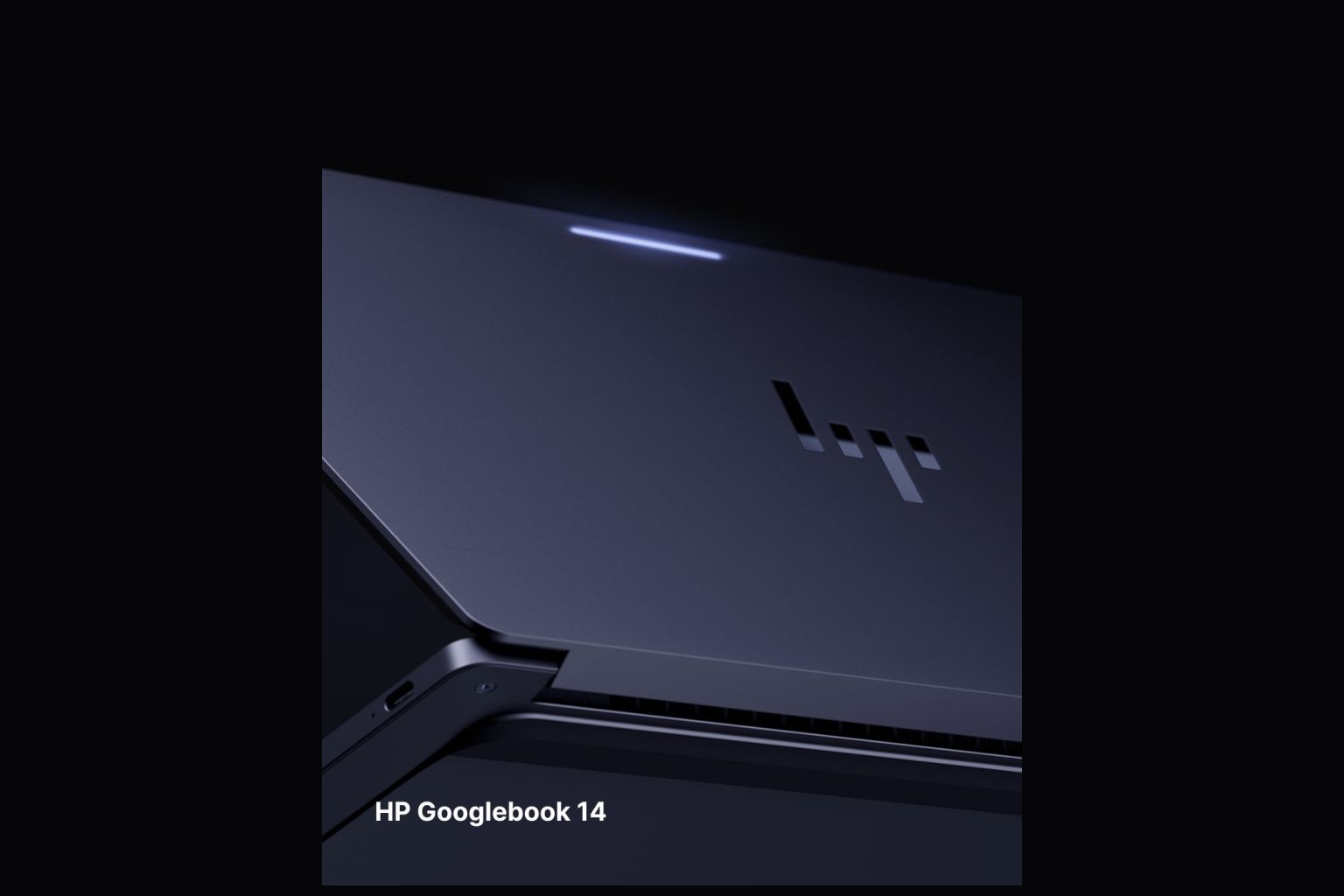
The HP Googlebook 14 knows how to make a good first impression. The announcement copy supplied with this article describes Atmospheric Blue, a sandblasted finish and a solid aluminum body, with a slim profile and an effortless, one-handed open. The supplied photo captures that restrained finish and the illuminated Glowbar on the lid.
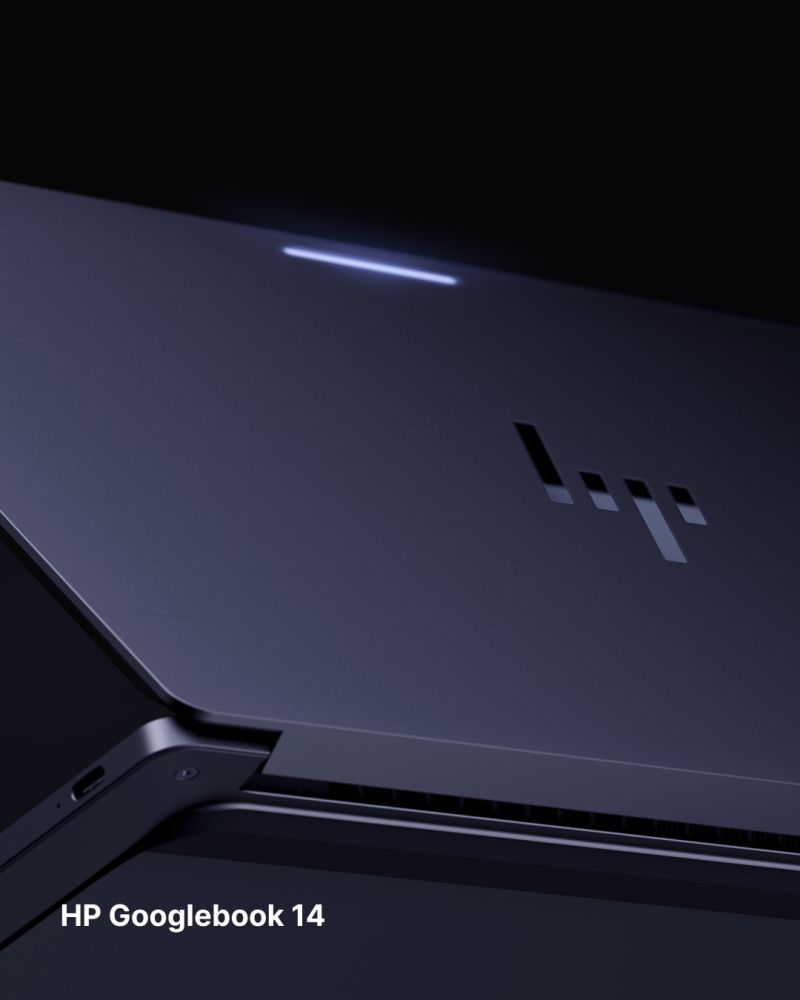
The details matter: the signature Glowbar, an ergonomic keyboard, a described haptic touchpad, OLED imagery and biometric login make the design story about everyday interactions, not just appearance. HP’s official announcement confirms a premium keyboard and touchpad experience and a 5 MP IR camera with facial recognition. It also explains that the Glowbar shows battery and charging status even when the laptop is closed. 3
A note on claims: The supplied copy quotes 10.99 mm thickness and 1.24 kg weight. HP’s launch announcement instead specifies 10.91 mm thickness; use the exact regional model’s specification sheet for dimensions and weight. The one-handed opening and haptic-touchpad descriptions come from the supplied copy, not our hands-on testing. We have not independently established that it is “the benchmark for the category,” so we treat that as promotional positioning rather than a measured verdict.
HP Googlebook 14 specifications at a glance
The processor, base memory, storage and detailed display figures below come from HP’s US product listing. 1 Maximum memory and storage options come from HP’s platform page. 2
| Specification | What HP lists | What to check |
|---|---|---|
| Operating system | Googlebook OS | Essential apps and Android phone compatibility |
| Processor | Snapdragon X Elite X1E-80-100; 12 cores, up to 4.0 GHz | Exact configuration and application support |
| NPU | Qualcomm Hexagon, 45 TOPS | Whether your chosen AI app actually uses the NPU |
| Graphics | Qualcomm Adreno | No discrete NVIDIA GPU listed |
| Memory | 16 GB LPDDR5x-8448 onboard; platform offers up to 32 GB | Choose capacity before purchase |
| Storage | 256 GB PCIe Gen4 NVMe SSD in the checked US listing; up to 1 TB advertised | Regional SKU and included SSD capacity |
| Display | Up to 14-inch 3K OLED touch, 2880 × 1800, up to 120 Hz | Not every regional listing has the same panel |
| Panel specification | 500 nits, 100% DCI-P3, 0.2 ms response time on the checked OLED configuration | Manufacturer figures, not our measurements |
| Camera and login | 5 MP IR camera with facial recognition | Biometric availability on the exact SKU |
| Audio | Quad speakers and HP Audio Boost 2.0 | Real-world clarity and volume |
| Thickness | 10.91 mm in HP’s launch announcement | Regional dimensions; supplied copy says 10.99 mm |
| Battery claim | Up to 19 hours in HP’s announcement | Workload, brightness and HP’s test conditions |
The camera, audio, thickness and battery claims are from HP’s launch announcement; they are not results from our own lab. 3
OLED: refinement you can see
The premium panel combines sharp text with OLED contrast and touch interaction. The 2880 × 1800 resolution gives a 16:10 workspace, while up to 120 Hz refresh makes scrolling and pointer movement smoother. HP lists 500 nits and 100% DCI-P3 for the checked US OLED configuration. These are specifications, not a guarantee of calibrated color accuracy. 1
Configuration matters. HP’s Canadian 14c-cf0000ca listing describes a 1920 × 1200 touch display, illustrating why buyers should check the full product number rather than assume every Googlebook 14 has the 3K OLED panel. 1
Gemini and Android: what the platform adds
The refinement sets the foundation for the software experience. HP describes Quick Access for moving between supported Android phones and the laptop, including phone files in the laptop’s file browser, and Cast my Apps for opening supported phone apps. Phone compatibility and feature requirements still matter. 3
HP also highlights Point to Ask Gemini: activating Gemini with a pointer wiggle to ask about selected content. Its dictation feature aims to turn spoken thoughts into cleaner text. That is a different proposition from installing a Windows AI utility: Googlebook is built around Gemini and the Android ecosystem. AI features may depend on account, connectivity, subscription and regional availability. 2
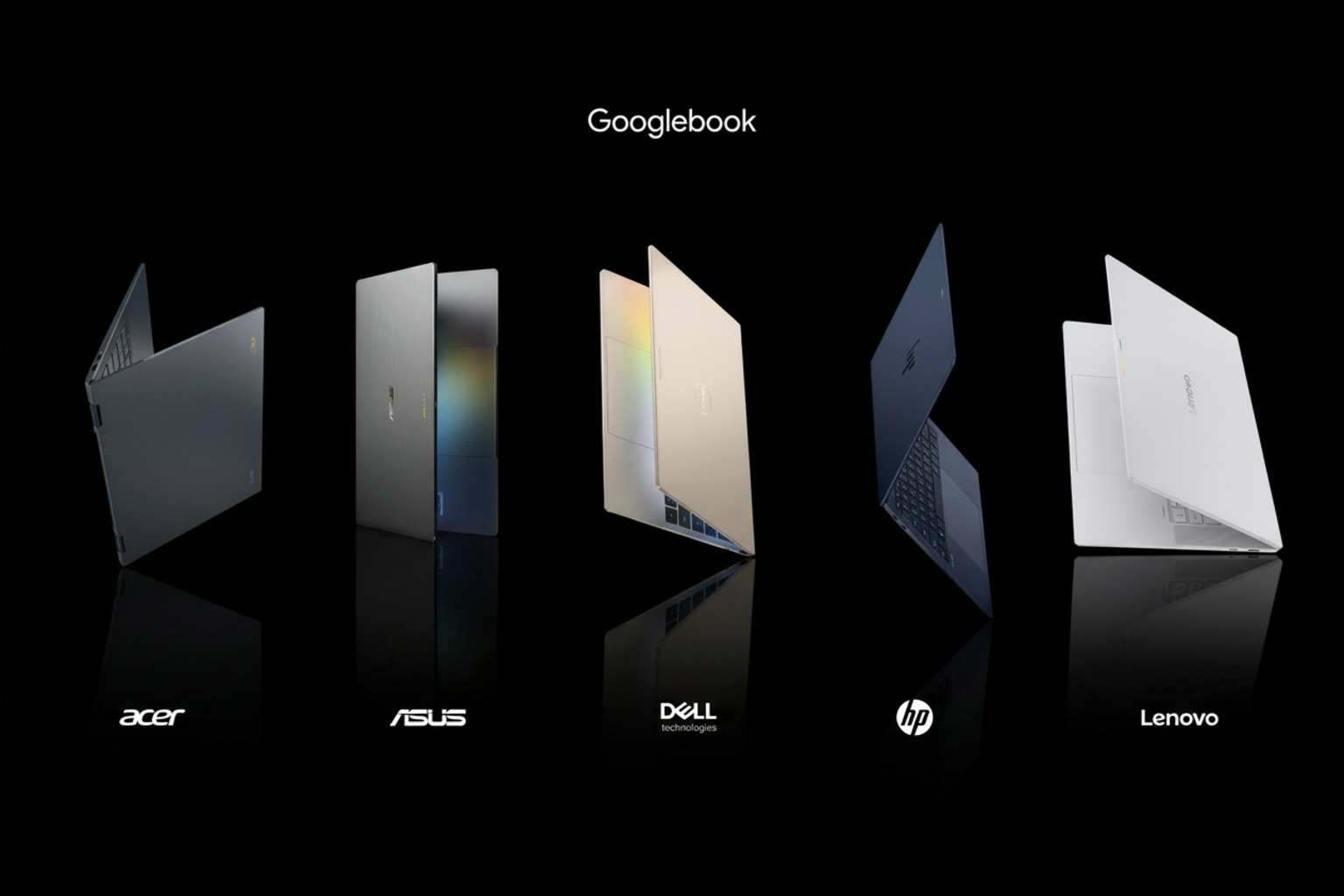
See our five-model Googlebook lineup overview for the wider platform comparison.
What 45 NPU TOPS does—and does not—tell you
45 TOPS describes the NPU’s advertised throughput, not a measured language-model generation speed. An application must support the relevant accelerator to benefit from it. A Gemini-branded feature is not automatically offline, and the presence of an NPU does not prove that every prompt stays on the laptop.
The base 16 GB configuration is sensible for everyday productivity, but operating-system and application memory leave less room for local models. Buyers planning local inference should investigate the 32 GB option, runtime support and memory requirements. Use our Local LLM & AI VRAM Calculator, local-LLM buying guide and benchmark database to compare supported workloads; we have no HP Googlebook 14 tokens-per-second result to claim here.
Buyer takeaway: Choose the HP Googlebook 14 for its Android-first workflow, OLED option and premium portability. Choose a local-AI workstation only after checking software support, usable memory and measured inference performance—not the NPU number alone.
Battery life and purposeful materials
HP claims up to 19 hours of battery life and describes vapor-chamber cooling and a compact USB-C GaN charger. Treat that battery figure as a manufacturer test ceiling, not an all-day guarantee under video calls, high brightness or AI workloads. 3
HP’s US product page says the chassis uses at least 50% recycled metal and lists EPEAT Gold with Climate+ certification. Its announcement also discusses recycled keyboard components, ocean-bound plastic and recycled or certified-source packaging. Those are useful design details, but durability and repairability still deserve separate scrutiny. 1
Who should shortlist it?
- Android-first professionals and students: phone-to-laptop continuity is the main reason to consider the platform.
- Frequent travelers: the slim body and lightweight design make it worth comparing against other premium ultraportables.
- Display-focused buyers: choose the actual 3K OLED configuration, not just the Googlebook name.
- Windows-dependent teams: verify business software, device management and peripherals before switching.
- Local-AI developers and serious gamers: confirm runtime and GPU compatibility; this is not a discrete-GPU workstation.
Price and availability: check the exact model
We are not publishing a universal starting price: configurations and regions differ, and HP’s checked US customizable page returned a $0.00 placeholder, which is not a usable purchase price. Nor do we claim that our partner inventories currently stock this exact model.
Compare HP inventory on AIPC.computer and laptops and notebooks on Accessories.computer. Confirm HP Googlebook 14, the full SKU, screen, memory, storage, charger contents and warranty before purchasing. These are partner inventory links, not a promise of an exact-model match or stock availability.
Our take and reporting method
The HP Googlebook 14 makes a credible case that the Android laptop category can feel premium from the first touch. Its Glowbar, OLED option and considered input design give the hardware a recognizable identity. Whether it becomes the category benchmark will depend on independent testing of battery life, thermals, keyboard and touchpad quality, application compatibility and sustained performance.
This is a specification-based product overview, not a hands-on review. We checked HP’s official announcement, platform page and regional product listings on 26 November 2026, separated manufacturer claims from measurements and flagged conflicting dimensions and display configurations. The photo and introductory craftsmanship copy were supplied for this article.
For alternatives, see the newest November laptops and our 2026 AI PC buyer’s guide.